





About Refugees, By Refugees
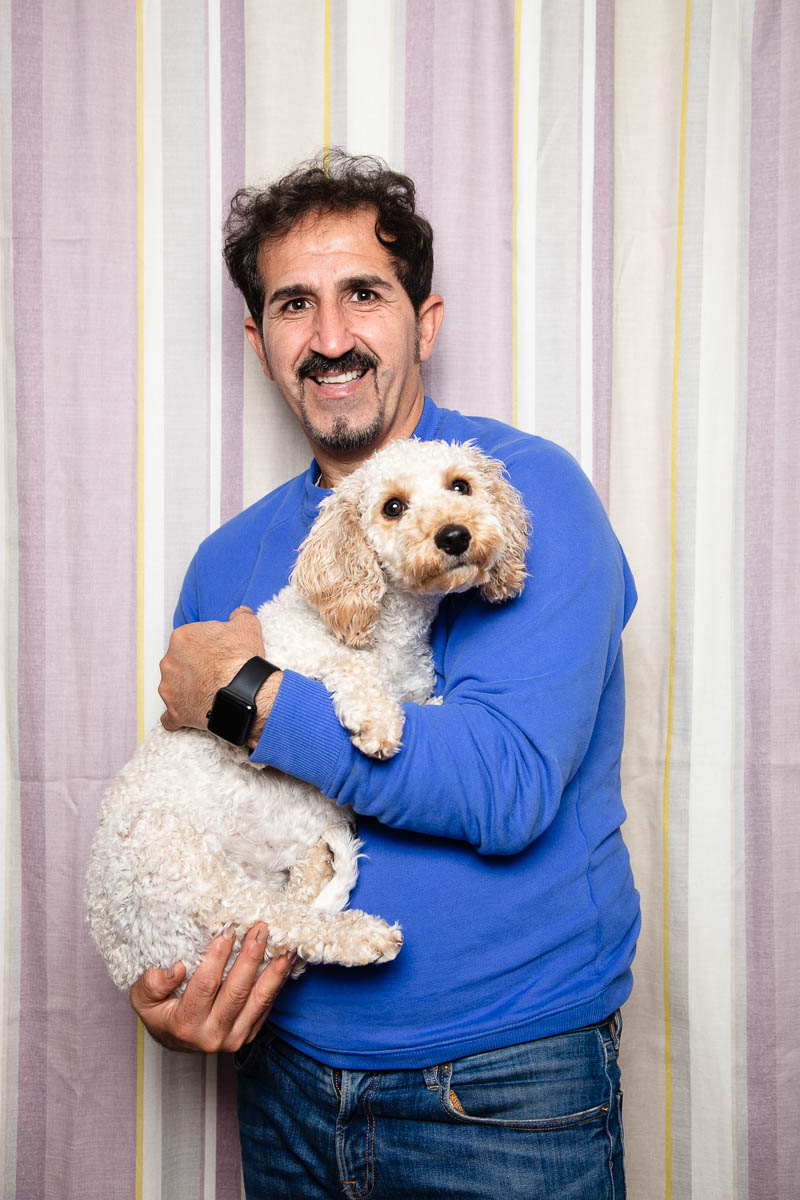
Salah Rasool
Pictures taken in:
From:
Nationality:
Photo and interview by:
“It is our duty to help people and prevent the growth of racism,” says Salah BabaRasool (42). Originally from Kurdistan, BabaRasool has lived in Britain since 2002. As a Kurd, he faced many hardships under Saddam Hussein. BabaRasool fled from Kurdistan as a result of the civil war and still suffers from PTSD. Nonetheless, he retains a positive outlook: “Life is hard if we make it so.” Upon his arrival in Britain, BabaRasool was subjected to racism, which he believes stems from ignorance: “They need education as well; it isn’t all their fault… We are all humans and together we are beautiful.” Starting as a cashier and volunteering at the Refugee Council, he worked up to a position in senior management. He is committed to learning languages, traveling, and fostering safe spaces for refugees. He acts as a role model within the community and seeks to promote a positive image of refugees in the country he now calls home: “Wales has become my first home, and Kurdistan is my second home now.”
full interview
Hello! My name is Bnar, a refugee in Britain. I have participated in a program called “1000 Dreams Refugees”. Our goal in collecting these stories is to change the perspective of the majority of Europeans or Brits towards refugees. You can introduce yourself.
It’s a pleasure. My name is Salah BabaRasool. I reside in Cardiff, Wales. I arrived in Britain on September 22, 2002 as a refugee and have lived here since.
Could you please describe the kind of house you currently live in?
Fortunately, I live in an almost super high-class house now. It’s been nearly a month since we moved in.
Thanks to God, it’s a big and spacious house with a sufficiently enough courtyard. I have two other houses in Cardiff in addition to this one.
Who shares the house with you?
I live with my Welsh wife and my two beautiful girls with the names of “Shano”, “Nusha”. We have a little cutie dog as well named, “Muvi”.
How do you spend your time? Do you work?
How do I spend my time? I spend my day with my faced glued to the computer screen from 9-5. Obviously, thanks to COVID-19, our daily work is entirely done at home either via Zoom or Microsoft Team or Skype.
I have responsibilities and I have a team. So, I have to work and supervise my team. And we have so many clients from different nationalities, since I have been in this job for so long now. So, i’m constantly slammed.
What makes you happy here in Britain, more particularly in Wales?
I have been living in this country for 18 years now. I have settled down and my wife is Welsh. I have always said that I was born in Kurdistan, but I was reborn in Wales again. I feel like I genuinely belong to this country to the point that I don’t feel as an outsider anymore. In fact, I consider it as my homeland.
How was your life when you first emigrated to here?
When I first arrived in Britain as a young adult, it was somewhat difficult for real. But what was good about it is that I did not quit overcoming all the challenges I had to face everyday by striving and hardworking. First, I started studying by taking ESOl classes and I had a part time job at Morrison supermarkets. I also had a night shift from 11 to 7 AM. Meanwhile, I volunteered at a Refugee Council once a week. I have not wasted a second since 2002 when I came here.
So, you started off as a volunteer at the place where you now hold a high position?
I have made a role model out of myself for what I have gone through for sure. It was not all about volunteering, but we had to care about making money, the families we left and learning English. I wanted to schedule my time and I greatly focused on studying. I wanted to improve my English because it is genuinely the backbone of our lives here. Meanwhile, volunteering made me socialize with the people from here and other communities. The best place for me to improve my English was the Refugee Council. Since my English was somewhat good, having graduated in Biology from Salahaddin University and having been a biology teacher in Kurdistan, I’ve helped the Kurdish community throughout my journey. But when I went into the Refugee Council, it started to spread. I interacted with other nationalities. All that and living among Welsh people benefited me a lot in addition to my job.
What is good about this country?
Do you mean Wales?
Yes.
Everything. You just have to know how to live. but as I said, if you work hard for it. I can say that Wales is a country where you have every opportunity in front of you at every stage of life. You can realize your dream.Believe me if I say that I have had the dream to sit in this very place for 10 years. And eventually, it came true. What I complained about since the beginning is houses. When you’re seeking asylum, they put you in a small house with 3 to 4 people, and I found myself thinking, ‘why is it that small?’ The same thing when I was given a flat. But I reached this level of life because of my hardworking thanks to God.
Very good. What is difficult about living in this country to you?
Indeed, life is hard if we make it so. But if we have a positive mentality, everything comes at hand positively. But if you wake up and start your day by consuming negative news and content, your day might as well be negative. Conversely, if you start your day with yoga and mindfulness, for example, you will have a positive day. I view life like that, we create difficulties in our lives. The obstacles on our ways are created only by us, humans, and we have to overcome them.
Can you please define your life? How do you feel about your life?
I can say that, at the moment, my life is near to perfect to some extent. I’m feeling on top of the world because I have a happy family here and I want to make everyone around me happy as well. I’ve reached an age, conviction and a level of lifestyle where I don’t have to chase money as refugees and other people do.However, everyone has the right to do so, but I want to give back now. Genuinely, I’m at a level where I have to serve others because of my job, my family and my surrounding.
Sometimes people tell me, “Aren’t you tired of people taking advantage of you?”
I’ve never had such thoughts because, as I said, we are all humans and together we are beautiful.
What made you start working in the Refugee Council.
As a refugee myself, it feels natural for me to be in such a place. It isn’t easy for the people who are fleeing their country to a new one without knowing its language, culture and every other thing in life which they are dependent on. We need the surrounding such as kids do. Therefore, I want to create a healthy environment for the refugees so that they don’t end up in trouble. To some extent, the majority of refugees are between 18 to 30 years old. Many of them have left their families, making them vulnerable to taking a wrong path and potentially ruining their life completely. Our job in the refugee council is to put them on a good track and education, and to encourage them. So, I’m truly glad, as I said, to have gone through all the stages; starting from volunteering, making my way up to a case worker and then becoming a manager. I am head of the council now in the senior management. All of this is a positive image for whoever emigrates to here.
Of course, it is. How do you feel to be away from your family and friends?
As I said, I have a family here now. My foremost family is the one here. But the big family, meaning the immediate family and relatives, is still there after 18 years of being away from them. You get to have a mother once in a lifetime, the same for siblings. So, I have tried to mingle my small family here to the big family as much as possible. We travel to Kurdistan as much as possible. We have another big family in Wales as well since my wife’s immediate family is here. She has two brothers. Her father passed away. He was a brigadier teacher at Bangor University. Her mother is still alive. So, we have another family here. The alienation has diminished in me to some extent.
Okay. Have you ever been subjected to racism since you arrived?
Unfortunately, racism has existed up until this moment. Racism has become more prevalent against refugees. You are aware of America and Trump in regards with racism and the same with Boris Jonson here. Unfortunately, these factors have contributed to the growth of racism. However, as the Refugee Council, we have an exclusive project called ‘Hate Crime.’ Through this initiative, we advise and educate people, urging them to inform us if they encounter any form of racism, no matter how small. We’ve told them to inform us if someone calls them, ‘Paki’ in the streets, because we have strong connection with the police. I myself, as a member of the Kurdish community, am constantly called upon in the council and by police department if there is any problem among the Kurdish community. As I said, it is our duty to help people and prevent the growth of racism.
I mean, has anything like that specifically happened to you?
Yes, i, myself, have been subjected to racism and shocked by it. For instance: last year, I was walking the streets of Cardiff Bay and two guys stretched their heads out shouting, ‘Fucking paki! Fucking paki!’ That term has nothing to do with me at all because I am Kurdish, but the racists don’t get that. They don’t know you, but they are racist against you because you are black and not from here. They aren’t also aware of your contribution to this country and the extent to which you have integrated with the society. But I genuinely feel sorry for them about that because they need education as well, it isn’t all their fault. The environment has turned them into that. So, it doesn’t sadden me much.
Have you ever thought that you would overcome this situation?
Overcoming my current situation or the past? because I have gone through several stages.
The situations you have gone through, have you thought you would overcome them?
The first step we take fleeing our country, we, as Kurds, would encounter many obstacles, tough and rough stages. When I fled my country, there weren’t Facebook, Instagram and Telephone around. If I am not mistaken, I contacted my family a year and 3 months later. Those stages were extremely difficult, having to walk 14 nights from Greece and spending 42 hours in a lorry. We passed all that. One, having to spend 7-8 hours of walking among the Iran-Iraq and Iran-Turkey mountains and having survived that, can get through every stage of life. The hardest stage you face when you arrive in Britain is dealing with Home Office and that nothing is in your power. You would be waiting for that very interview; you are left alone with yourself, your God and your luck. If you’re granted asylum, you can turn your life around completely. Otherwise, you’d have another chance to stand in front of a judge. I think you can get through the tough stages easier if you get asylum.
What about the pandemic, what did it teach you?
Unfortunately, the COVID-19 pandemic had taken away many people, but I found many personal benefits during that period. I was working constantly on the front-line during those 12 to 13 years at the refugee council. Although I was a manager, I didn’t take any breaks. I was under extra pressure from my and other communities as well. And I couldn’t say no to them, because I, as a role model, didn’t want to create a negative image. The pandemic striped me off working face-to-face and gave me a valuable opportunity during those 7 months to attend many powerful courses. For instance: I start OIS Level-2 this week. I finished ILM in leadership and management which opened my mind very much. And now, I have a lot more powerful relationship with my team as a refugee council in the sector. It was very useful, for me personally and my team as well, in many aspects.
Very good. Let’s switch it to your past, why did you leave your country?
Before I left my country, I studied at university for 4 years and was later employed for a maximum of 2 years.
Unfortunately, as a young teacher, the civil war just ended when I left and Kurdistan was split into 3 separate cities: Erbil, Sulaymaniyah and Duhok. Kurdistan separated from Iraq, being under an extreme siege domestically and from Iran and Turkey as well, we finished university but couldn’t return to Erbil. The civil war during 1997s and 1998s had a great impact on all my dreams and wishes as a young adult. It was like today’s situation with Home Office, you weren’t in charge of your life. Someone could have turned everything into nothing in a split second. I managed to get out of all that pressure.
How did you feel when left your county at that time?
Leaving your homeland after 22 years with all that is related to it such as family, culture, religion and everything, is indeed difficult. It was difficult to the point when I arrived in turkey after 7 days, I was singing Kurdish Songs just to be arrested and deported by the Turkish Jandarma. Luckily, I didn’t get arrested. I missed Kurdistan and I was worried about my job, thinking, “let’s go home before I get dismissed”. The problem is when you haven’t seen the world, your dreams are small.But once you’ve experienced the world,
gotten British passport, married a Welsh wife and are traveling to countries 4 to 5 times every year, then you realize how big people’s dreams can get. So, it depends on the surroundings which makes your dreams smaller.
How was it like to emigrate and what difficulties did you face? Could you please explain in detail?
I already explained it to some extent. The first thing I did to flee Kurdistan is to go to the border. We were walking on the mountains between Kurdistan and Iranian Kurdistan for about 8 hours led by the late smuggler. Then, they put the 20 of us in the back of a Toyota, which took us to a dusty bathroom. There, 14 of us got arrested and deported to Kurdistan and us, the rest, waited for them to return. Later, we traveled through Iran and the Turkey mountains. I was broke in Turkey, but I possessed good sewing skills and had made do by sewing with my teacher for 9 months and 15 days.I had been sewing during that period and raised roughly 900 dollars’ worth of money. But I hated living in Turkey because of their racism. I hated it to the point where I found myself and even many other Kurds saying, “I will not even fly over Turkey anymore”. Then, we walked to Greece for 14 nights which exhausted us, and spent 3 months and 14 to 15 days there sleeping on cardboards. I had been sewing there as well, earning about 300 dollars’ worth of money and headed to Italy later. In Italy, I spent 3 nights and 3 days in Rome sleeping on cardboards under the rain. Then, I headed to France and went to Holland where I settled for 4 years. I’ll talk about Holland in a bit where I sought asylum and had done sewing for 4 years. I didn’t have financial problems, but I hadn’t gotten asylum because of the government’s change of policy in that regard. Imagine after settling down for 4 years in a European country, with snap of a finger, I hopped on a lorry again and spent another 42 hours traveling from Belgium to here, and then to London. But the door to blessings opened to my face in Britain. I left home in 1997 with the intention of reaching Britain. After a solid 6 years, I arrived in Britain only to be granted asylum after 6 weeks. I was in England at that time. But when I came to Wales later, on crossing the bridge between them, I genuinely felt like I was returning to Kurdistan upon entering Wales. I have done many other online interviews in regards to my experience in Wales with Walsh newspapers. And I have expressed my feelings about it and its closeness to the feeling of returning home. In fact, Wales has become my first home, and Kurdistan is my second home now.
Why did you feel like returning home upon arriving in Wales? What has Wales given you?
That’s a good question. I had neither heard of Wales before nor had I known that they have their own language. But when we arrived, I found myself acknowledging a different language to English here because I knew something of English. For instance, the first word I saw was, “gwasanaeth” meaning services in stations where people take a little rest. After seeing that, a fellow of mine drove me to Swansea from Birmingham. There, we mistakenly made a stop at the best place in Swansea, Mumbles, with a beach and a little nice hill. It felt as Sulaymaniyah [a Kurdish city] with a beach. Imagine Sulaymaniyah surrounded by mountains and with a beach. It would feel like paradise. All of that contributed to my extraordinary love for this country and why I settled down with a Welsh wife here.
What is unforgettable about your journey?
I was extremely resilient against all the trials and tribulations which happened to me. But as my wife, Ruth, still mentions PTSD, I am still suffering from it, seeing recurrent flashbacks of the journey in my sleep. I’m still having dreams about my childhood, Saddam Hussein, killing, the chemical attack on Halabja and the civil war. Despite my strength and my belief in myself to be nearly perfect, although I never admit PTSD is something, it often brings tears to my eyes. In fact, I’m moved right now just by mentioning it because Kurdish people go through a lot of difficulties. We [Kurds] have too many problems. First and foremost, we don’t have an independent country, I don’t want to go into details. Secondary, we don’t have a standard language. Third, people don’t have sovereignty, everyone has been dominated by culture and religion.
And women don’t have a voice in our society. I sympathize my mom, sister and my female relatives. I see an extreme pain by means of social media platforms. There are two quite different sides. One of them introduces itself as the intellectuals, the other is inclining towards Salafism and Islamic extremism to some extent.
What are your strong points?
What I have found out about myself here in that regard is language, I speak 5 languages and sports since I live in the world of sport. I give that a 5 star. And perseverance, which is one of my strongest points, and the past, preventing it from holding me back to move on with my life. Another point is that I live in the present, quite opposite of people living for the future. I want to enjoy every moment of my life. Meanwhile, I’m looking forward to tomorrow.
What about the obstacles you faced in your life in Kurdistan?
We finished university without electricity. We didn’t have enough to eat, 1 kilo of sugar costed 70 Dinars at the time. Can you believe we would prepare tea by burning school papers? The civil war was happening at that time, and we were facing blockades, domestically and internationally. Yet, faced the challenges. Then, I was employed as a teacher, but they didn’t give us our salary which was 300 Dinars. People in Kurdistan are still suffering from being unpaid after 22 years! I mean, these are all challenges when you think about it. As I said, when you reach a different stage, become stable to some point and your mind broadens, these things start to hurt you. People are starting to suffer from salary-wise issues after 22 years! These are all caused by problems. These were all obstacles, If I talk about Kurdistan as well. Moreover, upon obtaining a bachelor’s degree, you’d find yourself in a job working 16 to 18 hours. It’s an absolute hell prepared for students. Then, straight from university to teaching without taking a break. I mean, what kind of life is that!
What were your dreams and desires when you were in Kurdistan?
I was narrow-minded to some extent back then. I had a little tendency towards Islamism. But I am glad about it, because on has to go through such stages. My communist brother, Khalid, who was a graduate of Mustansiriyah University, was leading the Shuras of demonstrations in all of Sulaymaniyah to some extent in 1991. I was working in our sewing shop and many of our clients were his communist and open-minded friends who are now at valuable positions. I was from a Sheikh family; my dad is a Sheikh. I was stuck between two opposing ideologies, but I kept them as my balance standard. Now, I know why I am told it is a balance, because this balance is crucial which has taken me to this level of life. I don’t cause clashes, I am a good listener and I listen to everybody. Then, I express my opinion and give my advice if possible. That type of balance is missing in cases of dealing with racists and refugees. I try to give people an opportunity to speak their mind.
What is your dream here in Wales?
Most of my dreams has come true here, but yet humans remain beautiful with dreams. Since I am financially stable, I want to help others and travel across the world more often especially Europe. I intend to travel to faraway places such as Japan, Mexico, Latin America and Thailand when COVID-19 goes away. And I want to pursue dreams related to my job such as exposing refugees to mindfulness which is crucial, since I am a trustee in the organization of Mindfulness Network and give back to people.
Very good. My last question is what is your message to Europeans regarding refugees, or if you could change their perspective, what’d tell them?
I try to change people’s perspective in that regard very much, to create a positive image. That’s why I care greatly about the Kurdish community. It’s on the shoulders of everyone who has come here. We should take it upon themselves. We can change and influence our surroundings to some extent, but the greater effect comes to play when everybody from their places influence as much as two people and then they could influence two other people. So, actions speak louder than words. In my opinion, intellect isn’t primarily about the numbers of books you’ve read, Doctoral degrees or graduating from university. These things aren’t worth a dime to me. Striving in this country is the opportunity to contribute to this country and genuinely integrate with the society. It’s better to stay away from Benefits in this country as much as possible in order to stand on your own feet. Language is crucial because I could change the perspective of a racist if they just sit with me for 30 minutes to narrate to them my story since the first six weeks until now that I have not taken a dime from the Job Center. I can proudly share this with anyone. I’m self-reliant. I’d debate anyone who is racist to me to measure who has paid more in taxes. This is a country of taxes which is very important.
Thank you.
Many 1000 Dreams interviews were not conducted in English. Their translation has not always been performed by professional translators. Despite great efforts to ensure accuracy, there may be errors.