





About Refugees, By Refugees
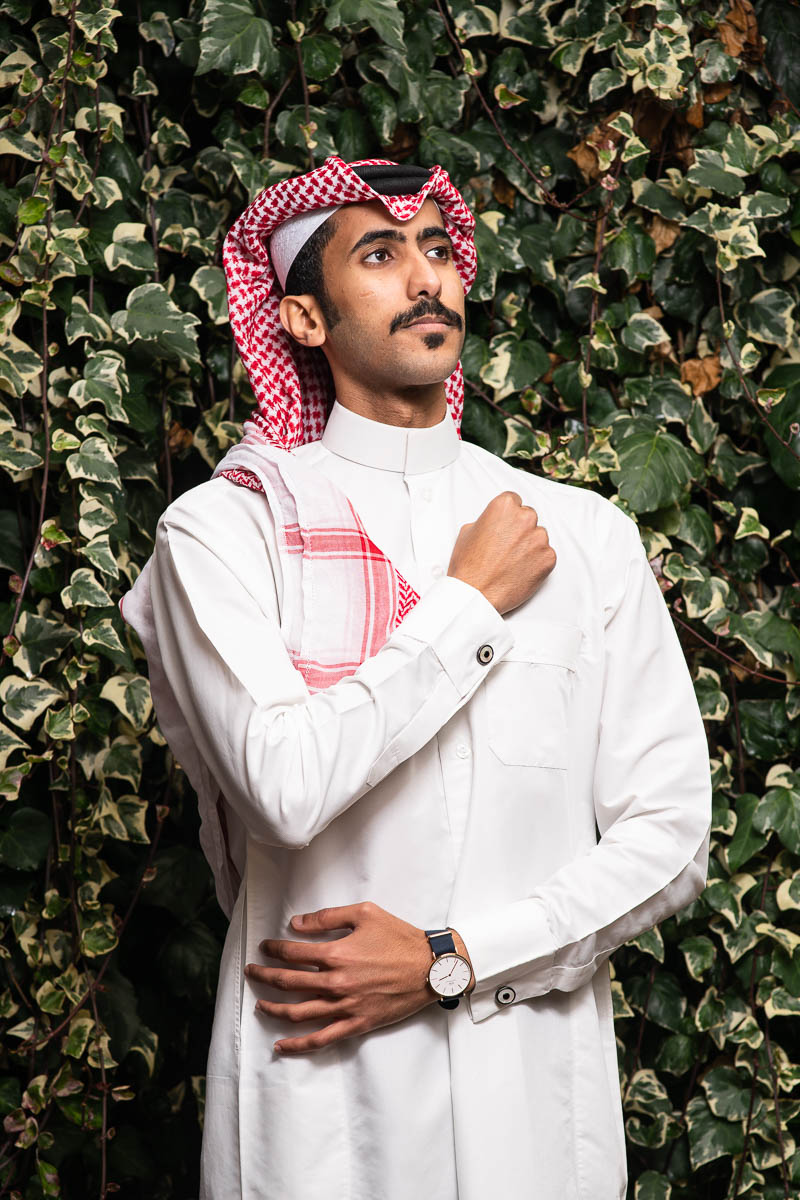
Abdullah Aljuraywi
Pictures taken in:
From:
Nationality:
Photo and interview by:
Abdullah Aljuraywi (pseud, 23) used to dream of a better future for his country. “In 2018 I received the news of the arrest of my cousin,” he recalls. “I felt that it was necessary for me to do something.” He began advocating for human rights and speaking out against the government: “The destruction Saudi authorities caused was much greater than all the effort of reformers…all the solutions available would lead me to prison.” Abdullah fled and now lives in London, working with a Saudi human rights group. Abdullah recalls that it was difficult to adapt, but he found support in community: “Fortunately, I went to the Red Cross Organization. They told me that they had a group of young people of the same age…This was an incredible thing for me.” While he is making efforts to change things from abroad, Abdullah still dreams of home: “The dream I really hope for is that there will be a real change in Saudi Arabia…so I can return safely to my home and can continue to work in human rights.”
full interview
Why did you request Asylum?
For my political opinions.
How old are you?
23.
What’s your job status?
I work full time as an advocate, a member of an organization supporting human rights. Abdullah. This interview is part of the 1000 Dreams project narrating stories of refugees; you work in human rights so you understand this, and we want to change the stereotypical image of refugees in Europe and how they’re viewed as greedy competitors who came to take jobs and goods leaving their countries willingly. We speak our own stories, and we want to spread the word that we were forced to leave our countries and we don’t have any options; we seek asylum in order to survive. First thing I want to ask you is where do you live now?
I live in London.
Is it a house or an apartment?
It is a shared apartment, instead of renting a whole apartment, which is very expensive, there are some shared apartments here in London. Each has a separate bedroom but we share the kitchen and the living room. So you live with roommates who are not your friends?
Yes, I didn’t know them before.
How do you spend your time?
I go to work from the morning until the evening. I work at AL-Qast Human Rights Organization. We record and document cases of violations committed by the Saudi authorities against detainees and violations in general. We report some people who are subject to violations inside Saudi Arabia or by the Saudi authorities. This is the nature of my work. I usually finish working at 6 pm but I really love my job so sometimes I stay at work until 9 or 8 pm.
So we can say that your work brings you joy.
Exactly because this is the work I’ve always dreamed of. When I was in Saudi Arabia, I really wanted to provide support for human rights. But because we in Saudi Arabia do not have any form of civil society organizations. We do not have any independent human rights associations and organizations, all of them are affiliated with the government. If you work with them, you often justify violations committed by the Saudi authorities, but if you actually defend human rights in Saudi Arabia, you get arrested. I felt that I couldn’t actually do something, but after I left Saudi Arabia, I arrived here to work. Honestly, I feel good about myself.
How’s your life been since you left Saudi Arabia and came here?
At first I was afraid of the future in a new country, different language, different weather and different people are different from us. We have nothing in common. Everything differs from my country, people with whom I lived, we speak the same language, we have the same customs and traditions, the same environment, the same weather, everything is different here. There was some kind of fear of the future, I lived today but what’s gonna happen tomorrow? What am I to do in a totally new environment in which I know no one and nothing about? But thank God with time I got to know many refugees, residents and other citizens. Thank God, I started to rebuild myself and have my own community. Thank God, I live comfortably.
Tell me about the difficulties you faced since you arrived in Europe
It’s difficult to adapt sometimes. I mean, there are many people who couldn’t adapt until now. Thank God, I am able to quickly integrate and adapt. Thank God that this is my character, but unfortunately it is difficult for some people to do so, especially in a place where you’re mostly treated like a stranger, let alone being a refugee, you are of a different color, your looks are also different thus you won’t be accepted by some people. Once they know you’re a refugee, they’ll think you’re here to steal their jobs and live on their taxes.
How did this make you feel?
I am a person who doesn’t care about the opinions of others. After all, I am a person who came here legally and in a regular manner. I follow the law. If you, citizens, are not accepting refugees and separating them from people you must know that the British government has played a role in supporting authoritarian governments. You must support putting pressure on the British government. For example, to stop selling weapons to the Saudi government, which caused the killing of Yemenis. If you are upset that a Yemeni refugee came to live in your country, you must pay attention to what your government is providing to destroy a country and contributing to its destruction. In the end, there is no doubt that after their country got destroyed, they’ll seek to live in dignity and freedom or to merely survive far away from there. They have the right to live and you reap as you sow.
I want to know how you feel when someone tells you these words? For example, do you feel pity for him, angry or hurt?
Thank God, I am learning more about people’s ideas, affiliations and way of thinking. If someone thinks of refugees like that, I can tell that he is an ignorant person, simple-minded and racist. This indicates that his mentality is limited and he doesn’t know much about life. I mean, a refugee is a normal human being just like you, what’s the difference? Whether it’s the color or the race, in the end those are just genetics things through generations. I mean, if a white man moves to the Middle East, after three generations, they will look just like the people of the country. Thus racism is just meaningless. It doesn’t make any sense.
So you just ignore it.
Yes, because only a very simpleminded person would think this way.
You used to live in Saudi Arabia with your family.
Yes of course, I lived with them my whole life, until I left Saudi Arabia.
Ok. Did you ever imagine living far away from them?
Honestly no, especially that I am a family-oriented person. I used to spend most of my time with my family, so the idea of leaving them suddenly and perhaps forever is very difficult and strange to me. But it was a step that I had to take, because if I don’t I’ll most likely end up in prison and also never see them again. So it’s better to not be able to see them while working on my goals and dreams to offer something to my people, my society and my family. It’s much better than spending my life in prison.
How does being away from your family make you feel?
There are pros and cons. The pros is that it makes you rely on yourself all the time. I mean, if you need anything or if you get into a problem, it’ll be your responsibility fully. You must learn everything. You are responsible for all of it, no one has anything to do with you. This is the positive side; I have somehow improved myself. The negative side of being away from family is that you love them and need to spend time with them even if it is for a couple of hours.
Do you feel that Europe or Britain is an alternative for your country?
It’s not an alternative. It’s more of a need or it is an alternative but not entirely. I mean, it is true that I came here to Britain. I am doing things I am deprived of providing to Saudi Arabia. I am contributing to building civil society, institutions with activists abroad, and those who work with them have contributed to building them. I mean, for example, AL-Qast Organization started by Mr. Yahya Asiri. I am currently working with him and he has contributed to building more than one institution in London and other places. This is what we are supposed to offer as activists abroad. We are trying to build civil society institutions. Since we are forbidden to build them in our countries, we must build them abroad and create the environment in which we live until we’re able to build them in our countries and we will all go succeed there, God willing.
You said that you started to have your own community. Does it mean that you are able to adapt to living here?
For me, thank God I was able to overcome many things and move forward. But there are many refugees who couldn’t.
If we compare between you and those people what are the things you were able to overcome and they couldn’t?
Building their own community which some people are afraid of. Some people have their own identity and opinions, they would never allow someone to impose anything that contradicts them. Trust of those who are able to overcome it. Some people are insecure because of their looks or color and they can not overcome it. Perhaps it’s because the people around them are the reason why. Here we are talking about countries that are considered materialistic. Most people only care about work and materialistic things, they don’t have time. We are talking about a society that is unable to breed acceptance and familiarity and help people integrate with each other.
How were you able to adapt to society here? How did you manage to get out of the phase of being an expatriate terrified of the unknown future?
Of course, God gave me the strength to do so. I tried to force myself to integrate with society. I mean, I was trying to learn from everyone. For example, I join organizations, participate in volunteer work with associations, companies or political parties. Anything literally, try to involve yourself in society as much as you can. This is a very important thing because you are in a new society, especially when you don’t know their language, it is difficult to start in any way. So I made use of any means of getting involved in society. In studying, work and social life, even when I buy some things or go shopping I try to talk to the seller so I can become more confident in myself and improve my language. From these simple things one begins to get involved.
Did you ever imagine going through such an experience?
Not at all honestly, I never expected it. I mean, I kind of had hope that there would be some reformation inside Saudi Arabia and we wouldn’t have to leave. We tried as much as we could. But in the end, you know what they say, the soul is willing but the flesh is weak. We can not change what we want to change, it’s not in the range of our power. Like they say, a single hand can not applaud. These things forced us to take the bold step of going abroad and start the other way.
As you were leaving Saudi Arabia, did you imagine being able to cope with the new situation?
As I said at the beginning, I had a great concern. I didn’t know what would happen tomorrow, I had this fear of having no idea what to do. My language was very, very weak and I couldn’t understand people and communicate with them. I wondered if there would be a problem, how do I solve it? How to use transportation. For example, in Saudi Arabia, we use our private cars. Here you have the train, metro and bus. All these things are new to you. But thank God over time it started. I got used to it and I thank especially the refugees whom I met and got to know them. They are really nice people who help each other and teach you how these things work.
Do you think that your ability to cope and the skills you developed were already there and you just used them or did you acquire them here?
I think both, there are some skills that I originally had and other skills I acquired. It’s been two years since I came here, but in those two years I learned more things than the twenty-two years I had spent in Saudi Arabia. I mean, these two years have taught me a lot, especially since I was on my own.
Why did you leave Saudi Arabia?.
At the time, I was a young man, like all young people in Saudi Arabia, living and enjoying my life and hoping to see my country in the best condition ever. A very energetic young man who tries to involve himself in community work and voluntary work in order to serve his country and try to raise it to its best condition. But we had a problem with repression and harassment, especially when we talk about human rights. It was a kind of harassment and suppression of human rights activists. In 2018 I received the news of the arrest of my cousin (redacted). After I received the news of her arrest at the time, I felt that it was necessary for me to do something. I knew that what I did was good but I realized that it wasn’t the thing that will save my country from that chaos. The destruction Saudi authorities caused was much greater than all the effort of reformers. There must be a bold step to address this injustice. I kept thinking about possible solutions or things I could do but all ideas would make me end up in prison, all the solutions available would lead me to prison. So the best solution that would ensure the continuity of my work without stopping was to go abroad and start working with Saudi activists and civil society institutions abroad. So I decided to leave. And I used to address those issues on Twitter, but I would delete them because of fear and threats. A few days before the killing of Khashoggi, the activist Omar Abdulaziz announced the electronic bee project, which is a project directed against fake accounts supported by the Authority. They were trying to create an illusion, I mean an imaginary public opinion. I mean, if the Saudi Authority says something these accounts would support it. If the Saudi authorities did something terrible, these accounts would defend it. So that project aimed to reveal this truth, so I entered into this project. After a while, I became the supervisor of one of the groups, the threats increased so I had to leave faster. So I left on 29th of January, 2016.
How did that make you feel?
The moment of departure was very difficult. I mean, imagine it the last time you see that house you just left, your neighbourhood, the shops, restaurants in which you have lots of memories, the markets, gardens and everything. Twenty-two years of living there came to an end and it might be the last time you see it. This idea was so difficult. Leaving Saudi Arabia and going to the airport, it was so difficult. When I was at the airport thinking that maybe this is the last time. When the plane took off, it’s probably the worst feeling ever. But at the same time, I had to do it. I told myself that it’s a fateful decision, you must endure it and you must be patient to overcome this, even if you go through difficult days. In the end, you must overcome it and start integrating yourself and start working. It was honestly a very difficult feeling to let go of everything, realizing it would all become just a memory. It’s hard to start in a new country, like I said. But thank God I managed to get through this phase.
Did you face any difficulty in your trip to Europe?
No, thank God, I am one of the people whose journey was easy. When I meet other refugees, poor people were forced to go through the sea and put their lives in danger. It was possible for them, I mean, to be killed or drown. But thank God I went to the airport in Riyadh and took the plane to London. My journey was seven hours and it was comfortable.
Did you have a specific strategy before you came or did you develop it here?
Technically, when I say that I have integrated myself with society, I don’t mean fully, 100%. There are many obstacles but I’m sure I’ll get through them with time because I managed to get through many harder things in the past. It often also depends on the people you choose to surround yourself with, they should be understanding and mindful, of course you shouldn’t be in contact with, for example, a racist person. Such people never accept you if you’re not like them. That’s why you should surround yourself with easy-going people. For example, those who associate with charitable organizations such as the Red Cross and others, there are some activities. Fortunately, I went to the Red Cross Organization. They told me that they had a group of young people of the same age, I mean, from 18 to 24 or 25. They’d have weekly meetings as well as trips and courses. This was an incredible thing for me. Fortunately, this organization helped me to be part of a nice group. This is a beautiful thing. One should target characters to exchange benefits. Not racist groups.
Do you often think of the events that forced you to leave Saudi Arabia, or did you forget about it?
Of course not, it is difficult for a person to forget such a thing. It’s a critical decision, I don’t think I’ll ever encounter such a fateful decision in my future again. I mean, that was a historical event in my life that is impossible to be forgotten. On the contrary, this memory will remain in my heart. Sometimes I say thank God. One day I’ll teach my children’s family about all the difficult times I was able to overcome to live a decent, liberated life.
What was your dream before leaving Saudi Arabia?
Honestly, I always had dreams about being arrested hahahaha.
Hahahah not the dreams while you’re sleeping, I mean your dreams for the future.
Honestly, I don’t deny that I am an ambitious person. I used to dream of being in a place where I can benefit my country, my people and myself. For example, be the head of a human rights organization in Saudi Arabia. But this is impossible there. Or to be, for example, minister in one of the ministries in which I can serve my country, but those positions are limited to specific families and titles. I mean we have class distinction in Saudi Arabia. You have to be the son of someone specific to get such positions. Even if you take it, you will have to make concessions and say things just in order to be able to complete the position and be safe from threats and arrests. It is known that any office holder or any well-known person in Saudi Arabia. I mean, they do not defend the ruling family, or the king, because they are just like trumpets to power and those. This is an impossible thing to accept for myself. I mean, I am a free person, I want to only say what I believe in, and to stand up against any violation or injustice. But I know if I face it, imprisonment will be my fate. And I can’t remain silent in a situation where I should raise my voice. All my dreams or ambitions were in Saudi Arabia were too far to reach unless I have make sacrifices that I don’t believe in.
As you were leaving, what were your dreams for the future?
Honestly, at the beginning I wanted to be, for example, a member of human rights organizations concerned with Saudi people, defending detainees, standing up against the injustice of authorities, join Human Rights Councils, because I wanted to be some kind of activist in this field. Thank God I am seriously heading towards that dream. I mean, I am currently walking this journey. I have chosen steps that I did not expect very quickly. I wouldn’t have taken any step towards my dreams had I been in Saudi Arabia but thank God, I have the space and freedom to do so here. I would like to thank all the people who believed in me and allowed me to find myself and be able to say and do what I want.
When you were in Saudi Arabia, where did you get your strength from?
I have kind of a leader personality, I’m patient and well-spoken. I know how to deal with people even in moments of anger in work. I know how to contain their emotions without having any hostility. This is one of the strength points I had in the past.
Did you maintain them?
Thank God, they increased.
But how?
Thank God, you can express everything you believe in here. You can say anything you want. You can be who you truly are without fear. You don’t have to follow what the society authority, or your family believe in. No, you can be your true independent self. You don’t have to be affected by society or the government. No one interfered with anyone. You are what you want. If you make a mistake, it’s your responsibility; if you do good, it’s for your own benefit. Thank God, here there’s freedom of thought, expressions, behavior and work, which pushes you to build a stronger character without being afraid of anything.
What are the positive things resulting from this experience?
The one biggest positive thing is that I no longer fear anything. Nothing can be harder than what I’ve been through. Anything I dream of or believe in seems easier because I’ve been through the most difficult things. Thank God I was able to overcome that situation and I’m sure that nothing in the future would be more difficult. I mean, I’m not afraid of anything ahead of me because I am confident in my ability to face anything in my way.
At the moment, what’s your dream?
I dream, I mean, the dream I really hope for is that there will be a real change in Saudi Arabia. A transition to a democratic system so I can return safely to my home and can continue to work in human rights inside Saudi Arabia without fear of being arrested. And to continue my journey. I mean, no matter how much the situation changes, we will not achieve perfection, but it is not a problem if you can work from inside the country without being afraid of arrest. This is a great opportunity. As soon as this happens I’ll return and finish my journey from inside Saudi Arabia and with the people of my country.
Thank you very much. if you want to add anything as a general message
This is a message to me and to all refugees abroad and those displaced from their homelands that you didn’t do anything wrong, and do not allow anyone to make you think the other way around. No, if you really came because you had a problem, fear of arrest in your country, insecurity, lack of feeling safe at home in your country, then you have the right to live in any land that you think is suitable for you. All humans are the same; there’s no difference between all colors, nationalities and languages, because those are nothing but social identities that symbolize a specific community. On the contrary, you did nothing wrong. Do not allow anyone to make you feel like a stranger or that you are not enough and know that only an insecure person would make you feel that way. This is your right as a human being. Do not worry about any racist, ignorant, aggressive person who has hatred for a religion, sect, community, language, or anything. He is ignorant, stupid and retarded and I believe that even the children of such a person would make fun of what he’d say one day. Because people are learning more and educating themselves more with time on equality and that all people are basically the same. Even if you go through difficult stages, just know that they all are temporary stages, so just keep going and do not care about anyone, I mean, who tries to harm you or affect your self-confidence. Try to choose the people you are comfortable with, whether refugees, residents, or anyone you feel comfortable with. Surround yourself with people who accept you for who you are rather than try to change you into what they want. Thank you very much.
Many 1000 Dreams interviews were not conducted in English. Their translation has not always been performed by professional translators. Despite great efforts to ensure accuracy, there may be errors.