


About Refugees, By Refugees
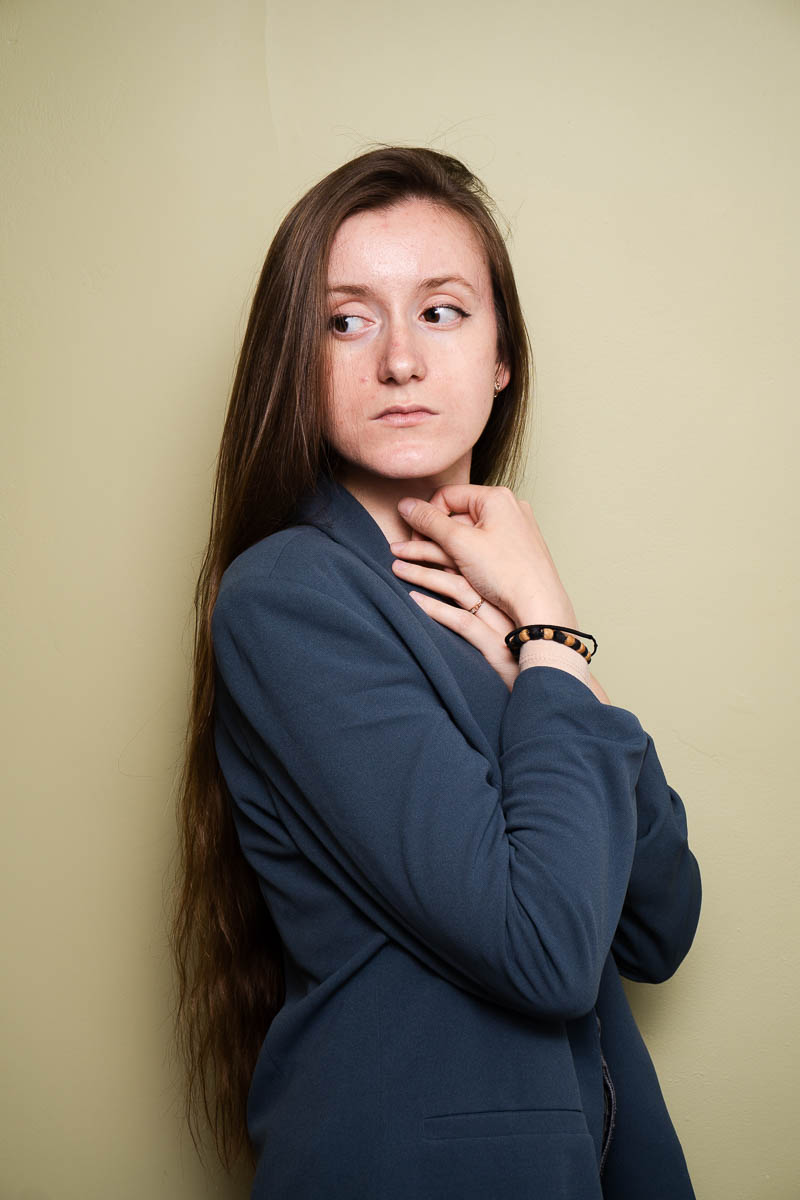
Ulia
Pictures taken in:
From:
Nationality:
Photo and interview by:
“When you are abroad, yes, you are safe; but you are not safe emotionally,” says Ulia (pseud, 24). Ulia used to be a journalist in Ukraine, but today she works in a kindergarden in New York City. It’s a job she finds difficult: “I want not to go back there, but to look for something else.” Despite the challanges, Ulia says: “My strength is that I am Ukrainian and I am very proud of it.” She lists her strengths before she left her home country as being able to adapt to situations, and not being picky about things, whether in life or work. But upon arrival in the US, her longing for home, family, friends and work made things difficult. Co-founding a Ukrainian NGO was one reason she stayed. It presents her the opportunity to speak about the Ukrainian invasion, and this makes her happy. She explains: “I found my mission here.” Ulia says she cannot imagine a future in another country. In her own words, “My dream is for Ukraine to win, and it’s not just our win, it is our future!”
Trigger Warning: War; violence
full interview
So Ulyana, tell me where you live now, and with whom?
I live in Park Slope, it’s a kindergarden, third floor. I live at work, but work in a different location.
With whom?
I live alone in a small room, two by three meters. Very small, but settled.
Are you comfortable there?
In a small room – yes. But when I go outside the room, it’s not so much, because the atmosphere is a bit pressurized. But in general, I am glad that I at least have somewhere to live and I am alone. I’m glad I’m alone. Because I don’t know how I would live with someone, share, for example, a space or just an apartment. It seems to me that it would be many times more difficult. When I lived in Ukraine, a full-scale invasion began. I lived in Lviv in a dorm, I also shared a room with a girl, but it was a dorm. This format is more understandable to me, because you still need to share a room with someone. When I was at home, living in the village already during the full-scale invasion, it was difficult for me to separate, because my grandmother lived in another room. We did not close the door. When I came here, it was important for me to have my own separate space and try to live by myself, to get a little away from people. Because when you come to another country, you have a lot of thoughts and difficulties that you face, and you just want to be alone with your thoughts, problems. And be alone as long as possible.
I will ask you about the difficulties a little later, but thank you for sharing. Tell me how you spend your time? Do you work?
I have been working in kindergarten for a year and five months. I hope that soon I will finish this activity. I work as a nanny with small children from three months to two years. This is difficult because the group is up to twelve children and small children. There are different situations. Every time you go to work, you think it’s the last time. I want not to go back there, but to look for something else.
And what is difficult in this work?
Emotionally, I think.
Tell me what brings joy and makes you happy?
In fact, I found my mission here. So I came here to see a relative because I didn’t know when I would see them because of a full-scale invasion, because no one knows when it will end and how long it will last. So I came to see them. But it so happened that I stayed longer. Why did I stay? Because I and other like-minded people, with Ukrainians who also came after a full-scale invasion and who have also been living here for several years, we founded the Ukrainian non-profit organization, the NGO Svitanok. Every week we hold protests, also events for the Ukrainian community, and not only for Ukrainian, but also for Americans, and for foreigners who support Ukraine. We also have an advocacy area. There is a co-founder of the organization, Vsevolod, who is engaged in this area, namely advocacy. And we are very grateful to Congressmen and to America in general, to those people who support us and to those people who signed this petition. And Ukraine will get help as soon as possible. This is what our team has been working on for six months. And not only our team, but also other organizations. In general, we have a united Ukrainian community in New York, which has worked on this issue. And not only on this issue, so we have a lot of plans for the future.
Why does it make you happy?
Because I feel that if I’m abroad, I have, I have the opportunity to speak and tell foreigners the truth in any way. This is one way. A public organization, its creation.
Tell me what was difficult for you when you came here? And what is complicated?
This is probably a longing for home, for family, friends, for work. Although I sometimes write remotely for Ukrainian media, in the first year it happened regularly. Since the creation of the NGO, I write quite rarely, but I try hard.
You’re a journalist by profession, right?
Yes, I am a journalist. In a public organization, I am also a photographer and chairman of the communication committee.
Can you describe how you feel living here, at a distance?
Interesting question. Sometimes I feel apathetic about everything. You come to the room and want to close off from the whole world. Communication sometimes absorbs very much, takes away energy from you. You don’t want anything. Especially events, shellings that take place every day in Ukraine. When you are abroad, yes you are safe, but you are not safe emotionally, that’s the first. Psychologically, this is the second. And it seems to me that if I were at home, maybe I would even somehow experience it all a little easier. Even to the sounds of sirens. Even if rockets fell on my town or village.
That is, all your relatives, friends, they are in Ukraine, right?
So, in Western Ukraine, parents live in the village. Friends scattered throughout Ukraine and the world.
So you’re saying it’s harder here than in Ukraine because you’re worried about them?
Yes, I worry about them. And in general for Ukraine, for every Ukrainian.
And you can tell a little more about how you feel when you are away from family?
I can give an example. Last year it was around April or May. My parents have always had this tradition. In general, every Ukrainian family has such a tradition to make dumplings. On Sunday, together. But on Saturday night it is 1 am at night here, in Ukraine it is eight in the morning. I make dumplings. I call my parents, and my parents also make dumplings. And so we just make three dumplings on a video call. It’s just such emotions, it’s such an unforgettable feeling. I can’t even describe. I think I’ll remember that for the rest of my life.
It’s very cute.
But the biggest difficulty is not to be in constant contact with relatives, because still phones, laptops, appliances, it does not transmit this bodily connection. Yes, you hear a voice, you see them, but you want to hug them, talk to them, to be with them.
I understand. Do you feel any discrimination here? As a migrant, or among other immigrants, has you faced discrimination in this country?
Well, there has not been such an experience yet.
Do you think people understand? Our experience of living in another country.
Other peoples or just Americans in general?
Can they understand what you and other people who have forcibly moved are actually living through?
It seems to me that only a Ukrainian will understand Ukrainian. Because we were there during the invasion of Ukraine, where a full-scale war began. And we felt it all on ourselves, we saw. If I was in Western Ukraine, it does not mean that we do not have missiles falling, we do not have air alarms, and so on. For example, missiles often fly over the roof of my house through my village. My mother calls me and always says that it is very scary. She hides, falls just falls on the street. Legs, hands shake. Very scary. You never know where it will fall. Why do they often fly? Because in our area there is a Burshtyn TPP, a power plant. The Russians are trying to… Well, every month, so to speak, I don’t know what frequency. But every month they shoot. Four blocks were damaged. Therefore, in order to restore this building, it will take decades. And we are only talking about Western Ukraine. And what about other parts of Ukraine, about Kiev.
Could you ever imagine that you could handle this situation? Or how do you deal with this situation while away from home? When is there a war in your country. How did you manage to survive? How do you live?
Very, very ambiguous. Yes, you really miss home. Yes, you really want to be at home because I know I can be useful at home as well. And this is not even discussed. But I see my mission here as well. The fact that I can be here, and the fact that we organize these protests, bring communities closer together. It is, it is all important. But I would never have thought that it could be so physically difficult for me in life. Just sometimes you come home and you don’t want anything, you just want to fall on the bed. And to cut it off just so that nothing happens. There were no assignments, there was no bad news. There are still some problems in the family. I just want to wake up and realize that all the Russians are dead, that they simply do not exist. That we can simply live in our own free independent country and they will no longer come to us and take away any piece of our land, nor kill our people, any number at all, from men to the elderly and children. When you realize how big this tragedy is, it grips you even more, because it’s all happening in your country. And so you do everything possible of yourself here. Yes, of course, I support my brother, who is in the Zaporizhzhya direction, in the East. Can I say that?
I think so. This is a fairly general question and we can then cut it out if necessary.
He’s not my family, but we’ve grown closer. And I was also here raising money for him, to provide for his crew. It’s all complicated. In general, war is a very difficult thing.
What skills do you think helped you? Are they helping you cope with today’s situation? What helps you hold on?
Apparently I’m hardy, maybe a little stress-resistant. Purposeful. But I am very doubtful of my actions, I am afraid that it may harm me. And very often I monitor tickets home. Sometimes it seems like everything is fine. Yes, we did, we see that there are results, and then it just covers with the wave that you devalue everything and just want to go home, to your room. You just want to go to your backyard. You just want to hug your relatives, see your grandmother. My grandmother has no leg. Catch her still alive because you don’t know when it will happen.
You think you must be hardy. How did it manifest itself or how does it manifest itself?
In this, the activity of our public organization manifests itself, because there is a lot of work, a lot of tasks. After working in the kindergarten, I come home and work for Svitanok. And it just goes on and on. It goes on every day, it’s very little sleep. I understand that it is necessary to return to the regime that was before, but it seems to me that while there is already a tenth year of war and two years of full-scale invasion, we wouldn’t recover, no rest. Until then, we will not have the kind of rest that people have in safe countries where there is no fighting.
How do you think refugees are treated in this country?
In fact, I met a lot of people, both foreigners and Americans, at the protests. But I am very grateful to them for supporting us, for coming, finding time. I would like many more people to see, chat live.
But in general, do people support?
People support. Ukrainians are immensely grateful to America, Americans, and peoples who support Ukraine both financially and non-financially. Even just walk up the street and say “I stand with Ukraine. I wanna hug you.” It’s inspiring.
Tell me a little bit for context why did you leave Ukraine? What happened?
In fact, it happened very spontaneously. I have had two aunts and three sisters living here for twenty years. I’ve always wanted to see them where they live, see how they live, see what environment they’re in, because it’s a completely different country. New York is a city of immigrants and people of very different cultures. Wanted to just see and feel how. Do they really support Ukraine, how do they support? I came to see my family. And so it happened that what remained. And it turns out that my two gestalts are closed because I saw them. And I saw them, and met the people who support us, and went to the protests, and created a public organization. But in fact, it would also be important for me to add that Russia attacked Ukraine. We did not attack them, but they attacked us, and they attacked ten years ago. And two years ago, full-scale. And a lot of people didn’t believe it. And a lot of people were preparing. And everyone has their own story, and everyone has their own questions, problems and so on. Maybe that was one of the reasons why I left. And maybe that’s one of the reasons why I’m still here. But I don’t think that’s the main reason, because I’m not afraid to go home. I’m not afraid to come and work in journalism and write about people, stories, reports. If there is an opportunity for me to go to the East of Ukraine, I will go, because I really want to. And another of my missions is what I feel. This is what I have dedicated six years of my life to. Because I studied to be a journalist for six years, and I do not want to leave this field while I work freelance. But I really hope that after I still decide to return home, I will return to my field and continue working. And I will continue to write about people and talk about Ukraine on those platforms that will be available to me, if it is only the all-Ukrainian media, okay. If there are international ones, it is many times better, because we will be able to write stories for an international audience. So that they understand what a horror is happening in our country.
Is there something, is there something specific that worries you and that you think about especially often?
“God, Ulyana, why did you leave, I have to go home.” If it weren’t for Svitanok, I would have been home a long time ago. because it is important to me when you are in another community, and at the same time people are being killed in your country. Well, it’s just a civic duty. To be with your people. And to experience, to be in the context of historical events. Because what is happening to us now is a story that is fixed for future generations. And if we don’t stop Russia now, Russia will go further and further and further. Once again, I would like to thank the countries that support us. And I am very grateful to our guys and girls. Which, despite the injury, despite the same fatigue, despite the lack of sleep, they wake up in the morning. And there are such days, I am sure that they do not go to bed at all. And just work for us, so that we have a place to live and work.
What do you mean?
They fight for us.
Those who serve in the Armed Forces of Ukraine?
Yes. Boys and girls, our servicemen. They fight for us to have a place to live, that we have someone to live with, that we have the opportunity to live in our homes, to be on our territory, to communicate with our people.
Is there something specific that worries you, that you think about especially often?
Of course. I especially often think about whether my parents will wake up the next day. Will my mother, father, grandmother, and relatives living in Ukraine survive? And it puts a lot of pressure on you. That’s why I want to go home. That’s why I know I’ll be home. Yes, I can be abroad. Of course, we want to win, but I will go when I see fit, when I feel that I have exhausted all my resources here, when I did everything I could do here for Ukraine. If I see that there are other people who can, whom I can rely on, to whom I can transfer a piece of my work, a piece of my responsibility. I’ll pass it on to them.
Tell me what you dreamed of as a child? What were your dreams before the war?
As a child, Ulia dreamed of being a singer.
You can say the same, but say the sentence “As a child, my dream was…”.
As a child, my dream was to sing, to be a singer. My profession is journalism. I love to take pictures, and I just adore theatrical art, voice acting and everything related to the voice, including vocals. But it turned out that I became interested in journalism. So the vocals have faded into the background, but I think it’s just as a hobby and of course I’ll be able to do that later. And if we talk about current dreams, among all Ukrainians it is one. Every day. The Armed Forces of Ukraine are doing everything to make this dream come true.
When you left your home, what did you dream about for the future? The moment you left. You can answer with the sentence “I dreamed that…”.
Interesting question. I dreamed that… Of course, I dreamed that everything would end as soon as possible, because every Ukrainian dreams every day that it would end as soon as possible. But it does not end, it continues, and the Russians continue to kill Ukrainians, every day, every day. So I don’t know if we are entitled to other dreams now. Apart from the main thing for the country to win.
Before you left Ukraine, what were your strengths? Did you manage to keep them?
That I can adapt to any situation. This helped me both at two universities in Ukraine and here. I am not too picky about things, life or work. Just when you don’t have the opportunity to have something better, you just take and try to do what you have now. You will not always work there or do this business, there will always be some other opportunities. You just have to survive this period and be able to tell yourself at the right time and at the right time “Stop. I can’t do that anymore. I feel like I can do more. I can leave, and do what I want, it’s my time, so I’m leaving.”.
You went through a lot of difficulties. Do you feel that you have grown as a result of your experience?
In general, it seems to me sometimes that I feel like a forty-year-old Ulyana, because this year and a half passed very quickly, and I still can not believe that I have not seen my relatives for so long. It seems that decades have just passed. It’s like the days are short at work, but the nights are very long.
Tell us what your hopes and dreams are for the future. Say also “My dream…”.
My dream is for Ukraine to win. And it’s not just my dream, it’s our future. It’s about our future, because I don’t imagine my future in another country. I can’t imagine my future without Ukraine, without my fields. Why fields? Because I’m from the village of Lan (“field” in Ukrainian). And I really like to say that.
Thank you very much for all the answers. Is there anything you would like to add that could help people better understand the immigrant experience and life here at a distance?
Never condemn people who have left the country under any circumstances, war or not war, or any other life circumstances. No need to judge, because we do not know what experience the person is going through right now. A lot of people think that when you go abroad, everything is great. A better life. But no. There is no better life. It is better to live only in your country, only where you were born. And, it seems to me, even when you leave, and if you are not a very strong patriot of your country and understand, how it was cool then. What an incredible city I have! What a beautiful village of mine! And how wonderful and friendly our people are! Simply the best! Therefore, I urge the migrants to unite with their people, to be with their people in a common circle, and to do everything to ensure that the wars end as soon as possible.
In one sentence can you say what the hardest thing has been for you in the year and a half while you are here.
Emotional component. You constantly want to go home, but at the same time you know that you are doing something important for the country even here. And you understand that there are few people, so you have to do what is necessary, because this mission is also here. Perhaps this emotionality is given the hardest.
Can you say in one sentence what your strength is?
My strength is that I am Ukrainian and I am very proud of it. And I am very proud of our people, who just with their hands, feet, various blades stopped Russian tanks and walked on them. And it’s actually very, very, very inspiring. I understand that our people are extremely brave and they will do anything to protect their people and their land. Because it’s our house, it’s not yours. This is our land. Everyone should understand. Everyone should understand this.
Thank you very much.
Many 1000 Dreams interviews were not conducted in English. Their translation has not always been performed by professional translators. Despite great efforts to ensure accuracy, there may be errors.