





About Refugees, By Refugees
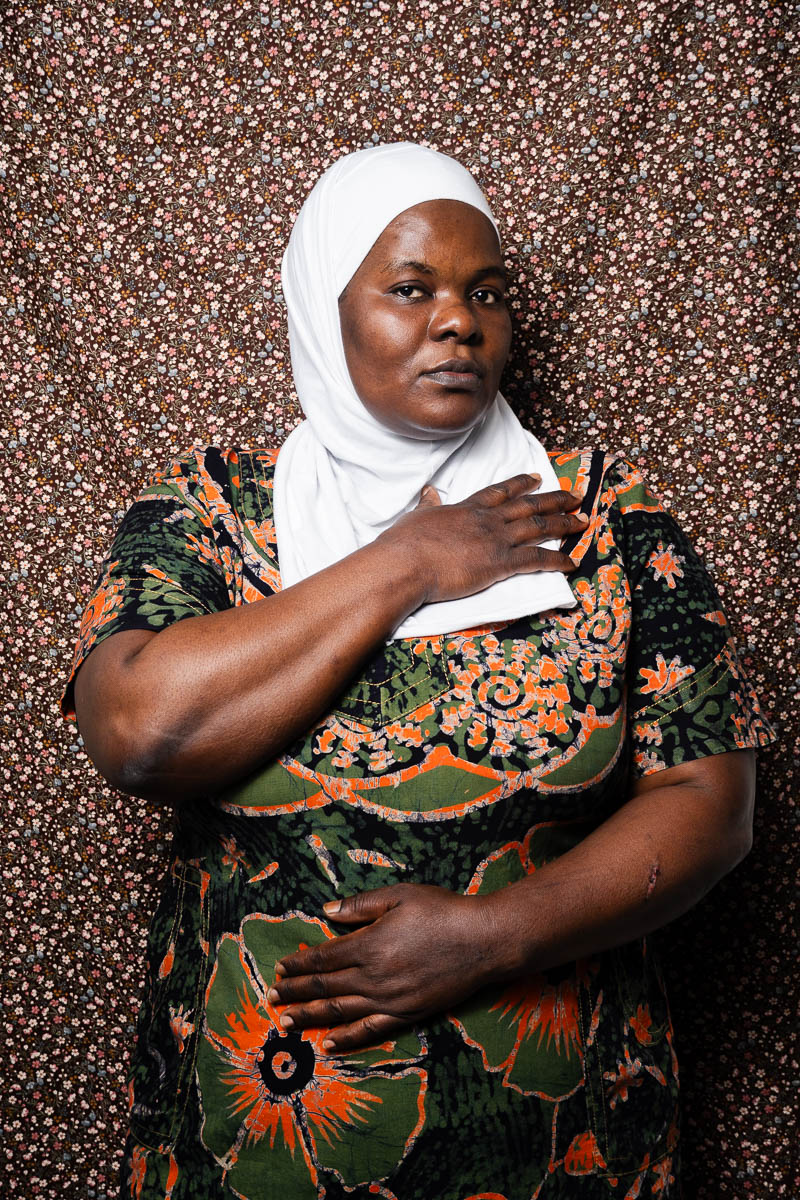
Sumaih
Pictures taken in:
From:
Nationality:
Photo and interview by:
“My dream is to be together with my family and being in a good life,” says Sumaih, 43, who came to the U.S. from Uganda with her three children to join her husband after a long separation. Life on her own was difficult. “I had no job. By the time he left, we were out of the house because we had no money.” She says those years gave her strength. “When you’re alone, you feel that nobody’s here to help… That is where I got that heart. And it made me strong.” In the U.S., Sumaih hoped for financial success. “My dream was to be rich, to get more money and to be the boss.” Instead, she struggles to make ends meet. “I’m depressed. Working too much. When you don’t work, you don’t eat.” She has also faced violence at the assisted living facility where she works—losing teeth when a patient kicked her in the mouth. “I had to go back and work the next day.” After complaining to her bosses, she says “ they ignored me because I’m black.” Still, her children’s education and higher wages help. “That makes me happy.”
full interview
So thank you Sumaih for accepting to be part of this interview, so I’ll repeat and say you’re going to have questions, you feel free to answer uhhh… the questions you’re comfortable with, anything you’re not, it’s okay, but we shall give whatever answers you’ve got. So what kind of housing do you live in and who do you leave with?
I’m renting and I’m living with my husband and my kids.
Oh, sure, and do you work?
Yeah, I’m working in the city.
Okay, that’s good, okay. How do you spend your other time?
I don’t even get time to spend around because I’m always busy with the kids.
What are some of the things you do that bring you joy or make you happy?
Being around with my family and around with my kids.
Okay, that makes you happy. That is quite good. Well, how has life been since you arrived?
Life has been up and down. Up and down, wow.
So what has been good about being here?
Being here, what has been good to me is… Get a good education for my kids. That is the first thing I’ve received from here and maybe getting living and like living with different kind of people like at work. And earning more money than which is better than at home because I used to get little money when I used to be in my country. But it’s too hard but it’s better than there.
What has been difficult about living here?
Uh living here when you have a big family it’s not easy and if you live like living here with many kids like the teenagers because i have all kinds of the ages: i have the teenagers, all the middles and face many challenges.
So how, can you describe how living here has made you feel? What feelings do you have when you think about living here? What emotions are attached to that?
I’m depressed.
Depressed, what’s, what causes the depression?
Working too much, because when you don’t work
Mm-hmm.
Too much bills fall on you
I know.
When you don’t work, you don´t eat,
That’s true.
And you have a big family.
Mm-hmm.
[coughing noise]. Many kids to cater for
I know.
It has not been easy for me,
I get that.
It is too tiresome for me
It is, mm-hmm. So I know…
No one to help. You’re the mother, you’re the brother, you are the sister. You are everything here, nowhere to run. So that’s a big challenge for me.
It is. So, how was being away from your husband because from the interview we know that you came after him. How did that make you feel?
It was ridiculous. Because when you live without a man, when you were used to be with your husband, and then your husband goes for some time. Yeah. I had no job.
Yeah.
By the time he left, we were out of the house because we had no money, we had a lot of problems when he left from Uganda to here. I had to go back to my mother. I was living with my mother, I had fight to get a job so that I can care for the kids because… because I had it three years, two years, and one who was going to one year. I had to look for money to find some alternative to get where I can work and then I get it for the kids. And I get a house to live with my babies because my husband was not there, everything. Because when he left, they moved away from that house and I decided to go back to my mom. So I had to look for a job, so that I can…
So I want you to tell me what was going into your mind. Why were you depressed during that time?
Of course. Having young babies, looking at them. You used to be in your husband’s house. He is the boss, everything. Now you’re going back home. Everything you have to say, I don’t have this, you know? Everything is not in, it is out of your hands. You’re going to another back home to be looked after, you know, it was not easy and when you have young babies.
Were you ever worried of what was going to happen to you tomorrow?
Of course, like you never know, I used to think what if this man doesn’t come back to me? We’re gonna have these three kids. So I had to think first so that I can work, so that to take care of the kids. Because even though he didn’t have the alternative, he told me that I’m just flat, I don’t know, so…
So could you ever have imagined that you would have been able to handle that situation before it happened? Have, have you… Okay. So do you think that you developed the ability to deal with these challenges or do you think you always had those skills before?
(Speaking another language)
You just developed the abilities…Like which abilities do you develop when you are going through that challenging situation?
Like working so hard, uh… taking too much care alone with my babies, you know, nobody was around me, paying the bills.
How are you able to handle the depression you are going through during that period?
Maybe I used to make myself working harder. That I forget everything on my mind. Because I used work, come back home, shower, sleep.
Are you a strong person?
Of course
How did you get that strength?
You know, when you, like in the situation where I was, I, I, he left from where he didn’t know that even I can work. But when there’s a time, when the time comes, when you’re alone, you feel that nobody’s here to help. You know you’re, you’re alone. That is where I got that heart. And it came into my heart and then it made me strong. Up to now.
How do you feel, how do you think refugees are perceived in this country, or immigrants are perceived?
It’s not really fair sometimes. In some cases, there are some situations where they are fair, some situations they are not. Espec…most especially where we go to work, we are being discriminated; mostly. It is highly common. Like, when they hear, like, you’re from Africa.
Mm.
They tell you, do you dress? Do you people dress?
Mmm.
You people put on dresses, they say you move naked.
Wow. How do you feel when they talk about that? How do feel when they talk?
Embarrassed.
You feel embarrassed?
Yeah.
Wow. So, how was your journey? Is there anything, can you tell me about your journey from your home to here? How hard was it? Is there anything which was really so difficult during that journey?
Like in how?
When you’re leaving like when you’re preparing to come, or on your way to here, is there any challenge you got along the way?
No. That was it. It was a good trip.
So how did you feel when you were leaving your country, coming to join your husband? What was…
Happy, because I was going to meet him. Yeah, but in other cases, leaving my family behind was also sad, sad, sad, you know.
Mm.
You’re coming here.
Hmm.
You’re happy, but you’re leaving your family behind. What am I going to find there?
I know.
What if is, you know?
I know.
You think about many things.
Mm… You’re right, that makes…
You’re going in a country where you can’t see anybody of your… you know.
Yeah, so do you have a support system here, like people who give you support when you’re going through those challenges you’ve told me about?
You deal with the depression in your house because sometimes people here, they can, they… if you talk to somebody, they can even tell you something which can make you even more depressed than you are. So sometimes you deal with that depression in your house.
So that implies you don’t have any support system?
No.
Okay. Before uh, the event that led your husband to leave your country, what were your dreams? What were your dreaming abo… what where your hopes?
Living good with my husband, having kids with better life, you know. Uhh, like improvement, like we can develop in our country, like building houses, developing our relatives, the sisters and brothers.
Hmm.
Having a good life, you know.
Okay. When you were leaving, coming here, what were your hopes and what were you dreams? (speaking another language), my dream was, I need to hear that. So as you left your country to come and meet your husband here, What were you hoping for? What were your dreams?
My dream was to be rich, to get more money and to be the boss.
Okay.
Like, because I admire people who are the boss ladies, you know.
I know.
They sit, like in my country, they sit there and then they have the workers do their work to make more money than I’ve ever had. That was my dream. And to devote my family and make a good future for my kids, like building better houses for our kids and then buying good land, bigger land.
Okay.
That was my dream.
Okay, before leaving your country, uh, what… what would you describe as your strengths?Like things you knew, these are my qualities and they helped me go through challenges. What were some of the strengths you had?
Like, uhh, can you explain that?
Like for me like, my strength are like I can persevere, it’s like I, I, uhh… I don’t give up, it is like something happens, I have to give in and say my strength.
Like my strength, I had to work.
Mm.
For a better life for my, for my… sisters and brother and for my family. That was my strength.
Okay.
And I’m still having that.
You’re still having that. What about how were you able to…, to…, to Handle challenges? Because we know sometimes people are broken by challenges.
Yeah.
So for you, what qualities do you have that helped you push through in that you are able to make it?
Silence.
Silence. Okay. Wow. So how does silence help you?
Because sometimes when you expose your emotions, the one you tell, you can tell somebody something and then the way you tell him or her is not the way they explain it to another person.
That’s right.
So the result is another case, so sometimes I keep myself silent.
Okay, so.
And I just pray to God to overcome that thing.
Do you ever, if something happens to you and you fall down, do you ever bounce back to go back and follow your dream even though you have gotten challenges around the world?
Yeah what a challenge here well like where i work, when i work in those assisted living with those people with like dementia and alzheimers the lady one day kicked me and i lost all my tooth.
Wow.
I complained to the facility, they never cared.
Mmm.
But I had to go back and work the next day. Until now, I’m still there. Yeah, but they ignored me because I’m black. I complained. Some people told me to sue the company, blah, blah. Then I said, this one is innocent. She doesn’t know what she’s doing. Maybe God will reward me for that. Because she never intended, but she doesn’t know what she is doing.
Yeah. So now, what are your hopes and dreams now as you’re here? What do you hope for? What dreams do you have as a person?
My dream is to become better than I am now. I want us to get a bigger house for our kids, because… uh… these things of separating like the houses the girls are living there and then the other ones are here you, you don’t know you’re not always on them. You don’t know what they’re doing. You do not know where they are.
Mm.
You don’t know what they talk, so you don’t know their ways. So my dream is to get a bigger house, live in good life. And to be together with my family. My dream is to be together with my family and being in a good life.
All right, thank you so much for having this interview with me. God bless you, and let me hope your dream comes true.
Thank you very much.
Thank you.
Nice to meet you.
Thank you so much.
Many 1000 Dreams interviews were not conducted in English. Their translation has not always been performed by professional translators. Despite great efforts to ensure accuracy, there may be errors.