





About Refugees, By Refugees
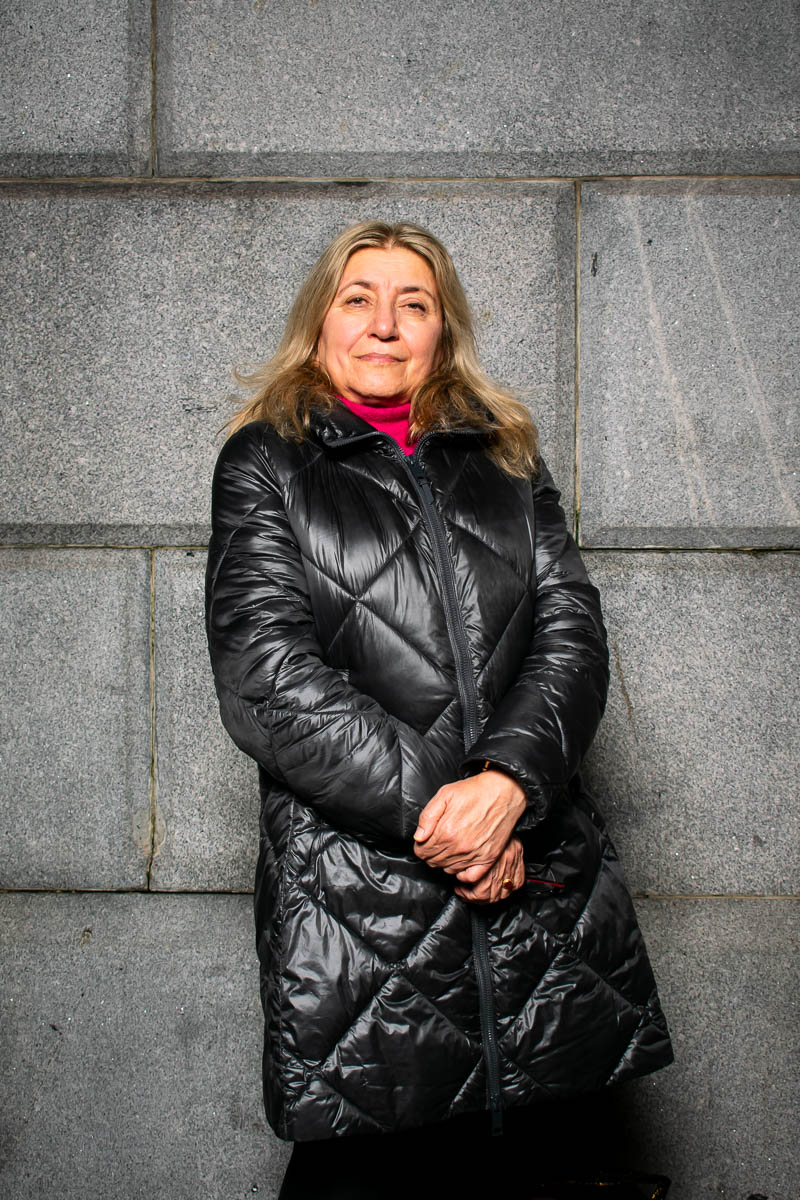
Mersedeh Ghaedi
“Instead of scaring me and holding me back, it forces me to move forward,” says Mersedeh Ghaedi (69). Ghaedi is from Iran, and immigrated to Norway after the Iranian revolution and her release from prison. “Everything we believed in was taken from us after the revolution and we were immediately suppressed.” Ghaedi spent eight years in prison for political activism, and says “dealing with this regime made me strong. Suppressing this regime made me more resilient.” She saw executions of children. Her brother was executed. She says “I stand here to stop the execution of people.” After she was released from prison, Ghaedi said life in Iran was different. “They wanted to build a different society with a whip that the people did not want.” Currently in London, she dreams of “a future where all people are free and can live.” While Ghaedi is separated from her family in Iran, she says “wherever I am, I want to be the voice of the Iranian people so that we can destroy this government.”
Trigger Warning: Death, violence, murder
full interview
Hello, can you introduce yourself? Hello, I am Mersedeh Ghaedi. Do I have to say my date of birth? I was born in Rasht (a province in Iran) on 10th of Bahman in 1333. I lived in Rasht until I was 17. Because my brothers were accepted to Tehran University, we also moved to Tehran. And we were in Iran until the Iranian revolution, which dates back to 1371, and I was in Iran until that year. And in 1371, I immigrated to Norway.
What was the reason for your migration and asylum? Yes. I grew up in a political family. Since 1350, we have been involved in the issue of freedom with the arrest of my brother by the Shah. Therefore, we entered the political arena until the revolution. I also became a political activist and was a member of one of the organizations at that time. In this regard, I was arrested in 1361 and was in prison for 8 years. While I was in prison, 3 members of my family were shot. After the liberation, I had to leave my homeland, I naturally did not like it. After the liberation, it was always controlled by the regime. Because I was sick, I stayed in Iran for a year or two, and then I had to leave Iran and come to Norway through Turkey and the United Nations.
The problems you had in Iran, you said that you were imprisoned and under pressure. How did these hardships make you feel? Emotionally, what can be called these feelings? It is a fact that everything we believed in was taken from us after the revolution and we were immediately suppressed. We were in the street with people. The enlightened society was severely suppressed and we were emotionally affected because we lost our loved ones. There is also a history in prison and the type of impact that breaks you or makes you strong. Fortunately, it did not break me. I continued to those ideals that I believed in and became strong. Until today, I live with the same strength as before and I chose to fight. After my exile, I still continue the struggle against the regime of the Islamic Republic. And during this time, I have lost my loved ones. My family is in Iran. Exile is something that makes you apart from your family, and it has separated us from our family in Iran. Especially since my family is in Iran and I lost 3 members of my family. But I still continue my struggle in exile.
When you were in Iran, what made you stronger against these hardships? Dealing with this regime made me strong. Suppressing this regime made me more resilient. I was in prison for 8 years and it is completely different from the prison now. In this era, there is torture in the prison, but in our era, this torture was very different. When I came out of prison, the community did not know what happened to me. Not that they didn’t know, in fact they didn’t want to know what happened to us. The regime was able to implement its religious laws with the whip. With a whip, not as people want. What you are seeing now is the result of 4 decades of struggle. We saw that government laws have no place in Iranian society. Because of this, there was a lot of pressure on us. Changes had occurred everywhere and men and women were separated. I was a nurse, they took my hat and put a scarf on my head. The differences were too big. They wanted to build a different society with a whip that the people did not want. I could feel the differences when I got out of prison.
What makes you able to stay strong? I believe in a community. A society where there is no death penalty or revenge. There should be freedom. Free people are thoughtless. Don’t be oppressed because of someone’s way of thinking. No one should have a ring on his neck because of his thoughts. I want a society where there is prosperity. Children should not work and there should be no poverty, prostitution and kidney selling. All these are my ideal dreams. These are the ideas I had at that time. There was also poverty in that novel, but it was different because the two histories are different. All these points that I said give me strength. In Scandinavia, I gained a special experience and learned one thing that I have to fight for all the things I think about. My war is also a resistance. Every day I wake up, I have to know what happened to my country today. Nooses have been placed on the necks of 22, 20, 17 and 16 year olds and I don’t want to see this again. Instead of scaring me and holding me back, it forces me to move forward. I can be the voice of my 20-year-old Iranian child. Wherever I am, I want to be the voice of the Iranian people so that we can destroy this government.
When you were in prison in Iran, what was your dream? If you say your sentence in such a way that this was my dream, what will it look like? I dreamed that my loved ones were not executed. I dreamed that my loved ones and friends would not be executed in front of my eyes. I dreamed not to see 16-year-old children go to execution. I dreamed that the revolution of 1357 would not have ended in blood. These were my dreams that I did not achieve. Iranian society has changed a lot in 1401 and I am happy about it. I dreamed that no one was in prison. When I was in prison, there were many 16- and 17-year-old girls, and I was their elder. I was a nurse. I dream that these points I mentioned did not exist.
I want to know what challenges you are facing now as a human being and what emotions do these challenges cause in you? We have very big challenges ahead. Challenges that exist in Iran. The challenge we have is when this war will end. This time too, we do not want our revolution to end in blood like in 1357. Do not appoint anyone. We did not bring Khomeini, but they brought Khomeini. They organized and appointed him as the leader, but they did not change the structure of the government and the army. People should know. Just today, a lady came and cursed me that if she was the king, this would not be the situation in Iran. No, if she had listened to my words, she would have known that the Shah was like the Islamic Republic. People should see the facts. The younger generation are decisive and they should understand what I am saying. I want them to make the right choice. They must accept unconditional freedom. What happens next? I think that with these facilities we have, we can choose much more consciously. We moved away almost 45-50 years ago and no one could hear us. I am now the voice of these children. I feel like there is a real war going on. And this war is not killing. War is to achieve a human life and to achieve a better world. No one was flogged for music. A woman should not be stoned to death for having a boyfriend. Everyone can do whatever they want. These are the ideals of a good life. People should go to university and study whatever they like and homosexuality should be free. If I tell my dreams, maybe it will be 20 pages long. My opinion is that every challenge should be discussed and we should not shut each other’s mouths. Today we see pictures of the execution. We have to look at them properly and not let them go. We have a plan to prevent this from happening again. We have to fight daily so that we don’t see images of people being executed anymore. That’s why I said that we are still at war. It is a society that has achieved great things. Now the children of the 80s know what they want. These requests may be time-consuming. I stand here to stop the execution of people. Let me say one thing that we can stop many things with our struggles. See, two people were executed in January. Every day, Iran’s sun rises with blood and its sun sets with blood. We have to end this. There is a big challenge ahead of us. We have to approach the things we want step by step. It was four decades of struggle that the slogan of the woman’s life of freedom was born. This slogan was not created overnight, people really fought for this slogan and it was passed down from generation to generation. We will continue to stand here until this stand is transferred to the next generation. These are the challenges before us.
In facing these challenges, what makes you overcome these problems and gives you strength? The important event that happened in 1401 was very important for me. After 1401 I got another power. The eighties came and stood in front of the government. These were the most beautiful days of my life. Crying and happiness are two dual emotions. We are both happy and sad. This dual feeling is always present in us. They executed my brother. I get depressed, but I am happy when my brother does not break in front of the regime. He did not appear on TV and did not confess. That is why this dual feeling is with us. What happened in 1401 gave me energy that we can continue. This is my view on the youth of Iran who can continue. I am really saying seriously that I love the youth of Iran who stood up against the Islamic Republic.
Now I want to know what is your dream? If you say that this is my dream, what will be your dream? Right now, my dream is that all executions be canceled and all prisoners be freed.
Thank you very much for your time. Is there anything you want to add? I hope for a very beautiful future. A future where all people are free and can live. I am one of those people who have been fighting for 50 years and I am alive to that hope and I know that we will reach that beautiful day of freedom with all the youth of my country and in Tehran’s Azadi Square. We will install the photos of all the loved ones who were taken from us in Azadi Square. Hoping for a beautiful day.
Thank you for your valuable time that you dedicated to us. Thank you for the chance you gave me.
Many 1000 Dreams interviews were not conducted in English. Their translation has not always been performed by professional translators. Despite great efforts to ensure accuracy, there may be errors.